Weathering is the breaking down of
rocks,
soils and
minerals as well as artificial materials through contact with the
Earth's atmosphere,
biota and waters. Weathering occurs
in situ, or "with no movement", and thus should not be confused with
erosion, which involves the movement of rocks and minerals by agents such as water, ice, snow, wind and gravity.
Two important classifications of weathering processes exist –
physical and chemical weathering. Mechanical or physical weathering
involves the breakdown of rocks and soils through direct contact with
atmospheric conditions, such as heat, water, ice and pressure. The
second classification, chemical weathering, involves the direct effect
of atmospheric chemicals or biologically produced chemicals (also known
as biological weathering) in the breakdown of rocks, soils and minerals.
[1]
The materials left over after the rock breaks down combined with organic material creates
soil. The mineral content of the soil is determined by the
parent material,
thus a soil derived from a single rock type can often be deficient in
one or more minerals for good fertility, while a soil weathered from a
mix of rock types (as in
glacial,
aeolian or
alluvial sediments) often makes more
fertile soil.
In addition many of Earth's landforms and landscapes are the result of
weathering processes combined with erosion and re-deposition.
Physical weathering

A
natural arch produced by erosion of differentially weathered rock in Jebel Kharaz (
Jordan)
Physical weathering is the class of processes that causes the
disintegration of rocks without chemical change. The primary process in
physical weathering is
abrasion (the process by which
clasts
and other particles are reduced in size). However, chemical and
physical weathering often go hand in hand. Physical weathering can occur
due to temperature, pressure, frost etc. For example, cracks exploited
by physical weathering will increase the surface area exposed to
chemical action. Furthermore, the chemical action of minerals in cracks
can aid the disintegration process. Physical weathering is also called
mechanical weathering, disaggregation.
Thermal stress
Thermal stress weathering (sometimes called insolation weathering)
[2]
results from expansion or contraction of rock, caused by temperature
changes. Thermal stress weathering comprises two main types,
thermal shock and
thermal fatigue. Thermal stress weathering is an important mechanism in
deserts, where there is a large
diurnal temperature range, hot in the day and cold at night.
[3] The repeated heating and cooling exerts
stress
on the outer layers of rocks, which can cause their outer layers to
peel off in thin sheets. The process of peeling off is also called
exfoliation. Although temperature changes are the principal driver,
moisture can enhance
thermal expansion in rock.
Forest fires and range fires are also known to cause significant weathering of
rocks and boulders exposed along the ground surface. Intense, localized heat can rapidly expand a boulder.
Frost weathering

A rock in
Abisko,
Sweden fractured along existing
joints possibly by frost weathering or thermal stress
Frost weathering, frost wedging,
ice wedging or
cryofracturing
is the collective name for several processes where ice is present.
These processes include frost shattering, frost-wedging and freeze-thaw
weathering. Severe frost shattering produces huge piles of rock
fragments called
scree
which may be located at the foot of mountain areas or along slopes.
Frost weathering is common in mountain areas where the temperature is
around the freezing point of water. Certain frost-susceptible soils
expand or
heave upon freezing as a result of water migrating via
capillary action to grow
ice lenses near the freezing front.
[4]
This same phenomenon occurs within pore spaces of rocks. The ice
accumulations grow larger as they attract liquid water from the
surrounding pores. The ice crystal growth weakens the rocks which, in
time, break up.
[5] It is caused by the approximately 10% (9.87) expansion of
ice when
water freezes, which can place considerable stress on anything containing the water as it freezes.
Freeze induced weathering action occurs mainly in environments where
there is a lot of moisture, and temperatures frequently fluctuate above
and below freezing point, especially in
alpine and
periglacial areas. An example of rocks susceptible to frost action is
chalk, which has many pore spaces for the growth of ice crystals. This process can be seen in
Dartmoor where it results in the formation of
tors.
When water that has entered the joints freezes, the ice formed strains
the walls of the joints and causes the joints to deepen and widen. When
the ice thaws, water can flow further into the rock. Repeated
freeze-thaw cycles weaken the rocks which, over time, break up along the
joints into angular pieces. The angular rock fragments gather at the
foot of the slope to form a
talus
slope (or scree slope). The splitting of rocks along the joints into
blocks is called block disintegration. The blocks of rocks that are
detached are of various shapes depending on rock structure.
Pressure release
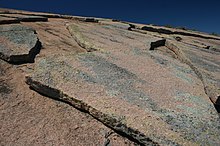
Pressure release could have caused the exfoliated granite sheets shown in the picture.
In pressure release, also known as unloading, overlying materials
(not necessarily rocks) are removed (by erosion, or other processes),
which causes underlying rocks to expand and fracture parallel to the
surface.
Intrusive igneous rocks (e.g.
granite)
are formed deep beneath the Earth's surface. They are under tremendous
pressure because of the overlying rock material. When erosion removes
the overlying rock material, these intrusive rocks are exposed and the
pressure on them is released. The outer parts of the rocks then tend to
expand. The expansion sets up stresses which cause fractures parallel to
the rock surface to form. Over time, sheets of rock break away from the
exposed rocks along the fractures, a process known as
exfoliation. Exfoliation due to pressure release is also known as "sheeting".
Retreat of an overlying glacier can also lead to exfoliation due to pressure release.
Hydraulic action
Hydraulic action occurs when water (generally from powerful waves)
rushes rapidly into cracks in the rock face, thus trapping a layer of
air at the bottom of the crack, compressing it and weakening the rock.
When the wave retreats, the trapped air is suddenly released with
explosive force.
Salt-crystal growth
Salt crystallization, otherwise known as
haloclasty, causes disintegration of rocks when
saline solutions seep into cracks and joints in the rocks and evaporate, leaving salt
crystals behind. These salt crystals expand as they are heated up, exerting pressure on the confining rock.
Salt crystallization may also take place when solutions
decompose rocks (for example,
limestone and
chalk) to form salt solutions of sodium
sulfate or
sodium carbonate, of which the moisture evaporates to form their respective salt crystals.
The salts which have proved most effective in disintegrating rocks are
sodium sulfate,
magnesium sulfate, and
calcium chloride. Some of these salts can expand up to three times or even more.
It is normally associated with
arid
climates where strong heating causes strong evaporation and therefore
salt crystallization. It is also common along coasts. An example of salt
weathering can be seen in the
honeycombed stones in
sea wall. Honeycomb is a type of
tafoni,
a class of cavernous rock weathering structures, which likely develop
in large part by chemical and physical salt weathering processes.
Biological effects on mechanical weathering
Living organisms may contribute to mechanical weathering (as well as chemical weathering, see 'biological' weathering below).
Lichens and
mosses
grow on essentially bare rock surfaces and create a more humid chemical
microenvironment. The attachment of these organisms to the rock surface
enhances physical as well as chemical breakdown of the surface
microlayer of the rock. On a larger scale, seedlings sprouting in a
crevice and plant roots exert physical pressure as well as providing a
pathway for water and chemical infiltration.
Chemical weathering
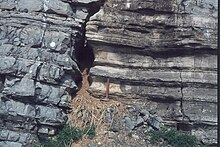
Comparison of unweathered (left) and weathered (right) limestone.
Chemical weathering changes the composition of rocks, often
transforming them when water interacts with minerals to create various
chemical reactions. Chemical weathering is a gradual and ongoing process
as the mineralogy of the rock adjusts to the near surface environment.
New or
secondary minerals develop from the original minerals of the rock. In this the processes of
oxidation and
hydrolysis are most important.
The process of mountain block uplift is important in exposing new
rock strata to the atmosphere and moisture, enabling important chemical
weathering to occur; significant release occurs of Ca++ and other
minerals into surface waters.
[6]
Dissolution and carbonation
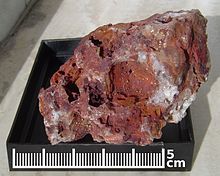
A
pyrite cube has dissolved away from host rock, leaving
gold behind
Rainfall is
acidic because atmospheric
carbon dioxide dissolves in the rainwater producing weak carbonic acid. In unpolluted environments, the rainfall
pH is around 5.6.
Acid rain
occurs when gases such as sulfur dioxide and nitrogen oxides are
present in the atmosphere. These oxides react in the rain water to
produce stronger acids and can lower the pH to 4.5 or even 3.0.
Sulfur dioxide, SO
2, comes from volcanic eruptions or from fossil fuels, can become
sulfuric acid within rainwater, which can cause solution weathering to the rocks on which it falls.
Some minerals, due to their natural solubility (e.g.
evaporites), oxidation potential (iron-rich minerals, such as
pyrite), or instability relative to surficial conditions (see
Goldich dissolution series) will weather through
dissolution naturally, even without acidic water.
One of the most well-known solution weathering processes is
carbonation, the process in which atmospheric carbon dioxide leads to solution weathering. Carbonation occurs on rocks which contain
calcium carbonate, such as limestone and chalk. This takes place when rain combines with
carbon dioxide or an
organic acid to form a
weak carbonic acid which reacts with calcium carbonate (the limestone) and forms
calcium bicarbonate.
This process speeds up with a decrease in temperature, not because low
temperatures generally drive reactions faster, but because colder water
holds more dissolved carbon dioxide gas.
[citation needed] Carbonation is therefore a large feature of glacial weathering.
The
reactions as follows:
-
- CO2 + H2O => H2CO3
- carbon dioxide + water => carbonic acid
-
- H2CO3 + CaCO3 => Ca(HCO3)2
- carbonic acid + calcium carbonate => calcium bicarbonate
Carbonation on the surface of well-jointed limestone produces a dissected
limestone pavement. This process is most effective along the joints, widening and deepening them.
Hydration
Mineral hydration is a form of chemical weathering that involves the rigid attachment of H+ and OH- ions to the atoms and molecules of a mineral.
When rock minerals take up water, the increased volume creates physical stresses within the rock. For example
iron oxides are converted to
iron hydroxides and the hydration of
anhydrite forms
gypsum.
Hydrolysis on silicates and carbonates
Hydrolysis
is a chemical weathering process affecting silicate and carbonate
minerals. In such reactions, pure water ionizes slightly and reacts with
silicate minerals. An example reaction:
-
- Mg2SiO4 + 4H+ + 4OH- ⇌ 2Mg2+ + 4OH- + H4SiO4
- olivine (forsterite) + four ionized water molecules ⇌ ions in solution + silicic acid in solution
This reaction theoretically results in complete dissolution of the
original mineral, if enough water is available to drive the reaction. In
reality, pure water rarely acts as a H
+ donor. Carbon dioxide, though, dissolves readily in water forming a weak acid and H
+ donor.
-
- Mg2SiO4 + 4CO2 + 4H2O ⇌ 2Mg2+ + 4HCO3- + H4SiO4
- olivine (forsterite) + carbon dioxide + water ⇌ Magnesium and bicarbonate ions in solution + silicic acid in solution
This hydrolysis reaction is much more common.
Carbonic acid is consumed by
silicate weathering, resulting in more
alkaline solutions because of the
bicarbonate. This is an important reaction in controlling the amount of CO
2 in the atmosphere and can affect climate.
Aluminosilicates when subjected to the hydrolysis reaction produce a secondary mineral rather than simply releasing cations.
-
- 2KAlSi3O8 + 2H2CO3 + 9H2O ⇌ Al2Si2O5(OH)4 + 4H4SiO4 + 2K+ + 2HCO3-
- Orthoclase (aluminosilicate feldspar) + carbonic acid + water ⇌ Kaolinite (a clay mineral) + silicic acid in solution + potassium and bicarbonate ions in solution
Oxidation
Within the weathering environment chemical
oxidation of a variety of metals occurs. The most commonly observed is the oxidation of Fe
2+ (
iron) and combination with
oxygen and water to form Fe
3+ hydroxides and oxides such as
goethite,
limonite, and
hematite.
This gives the affected rocks a reddish-brown coloration on the surface
which crumbles easily and weakens the rock. This process is better
known as '
rusting',
though it is distinct from the rusting of metallic iron. Many other
metallic ores and minerals oxidize and hydrate to produce colored
deposits, such as
chalcopyrites or CuFeS
2 oxidizing to
copper hydroxide and
iron oxides.
Biological weathering
A number of plants and animals may create chemical weathering through
release of acidic compounds, i.e. moss on roofs is classed as
weathering. Mineral weathering can also be initiated and/or accelerated
by soil microorganisms.
Lichens
on rocks are thought to increase chemical weathering rates. For
example, an experimental study on hornblende granite in New Jersey, USA,
demonstrated a 3x - 4x increase in weathering rate under lichen covered
surfaces compared to recently exposed bare rock surfaces.
[7]
The most common forms of biological weathering are the release of
chelating
compounds (i.e. organic acids, siderophores) and of acidifying
molecules (i.e. protons, organic acids) by plants so as to break down
aluminium and
iron containing compounds in the soils beneath them.
Decaying remains of dead plants in soil may form organic acids which, when dissolved in water, cause chemical weathering.
[citation needed] Extreme release of chelating compounds can easily affect surrounding rocks and soils, and may lead to
podsolisation of soils.
The symbiotic
mycorrhizal fungi
associated with tree root systems can release inorganic nutrients from
minerals such as apatite or biotite and transfer these nutrients to the
trees, thus contributing to tree nutrition.
[8]
It was also recently evidenced that bacterial communities can impact
mineral stability leading to the release of inorganic nutrients.
[9]
To date a large range of bacterial strains or communities from diverse
genera have been reported to be able to colonize mineral surfaces and/or
to weather minerals, and for some of them a plant growth promoting
effect was demonstrated.
[10]
The demonstrated or hypothesised mechanisms used by bacteria to weather
minerals include several oxidoreduction and dissolution reactions as
well as the production of weathering agents, such as protons, organic
acids and chelating molecules.
Building weathering
Buildings made of any stone, brick or concrete are susceptible to the same weathering agents as any exposed rock surface. Also
statues,
monuments and ornamental stonework can be badly damaged by natural
weathering processes. This is accelerated in areas severely affected by
acid rain.
Gallery
-
The surface pattern on this pedestal rock is
honeycomb weathering, caused by salt crystallisation. This example is at
Yehliu,
Taiwan.
-
Salt weathering of building stone on the island of
Gozo,
Malta
-
-


